
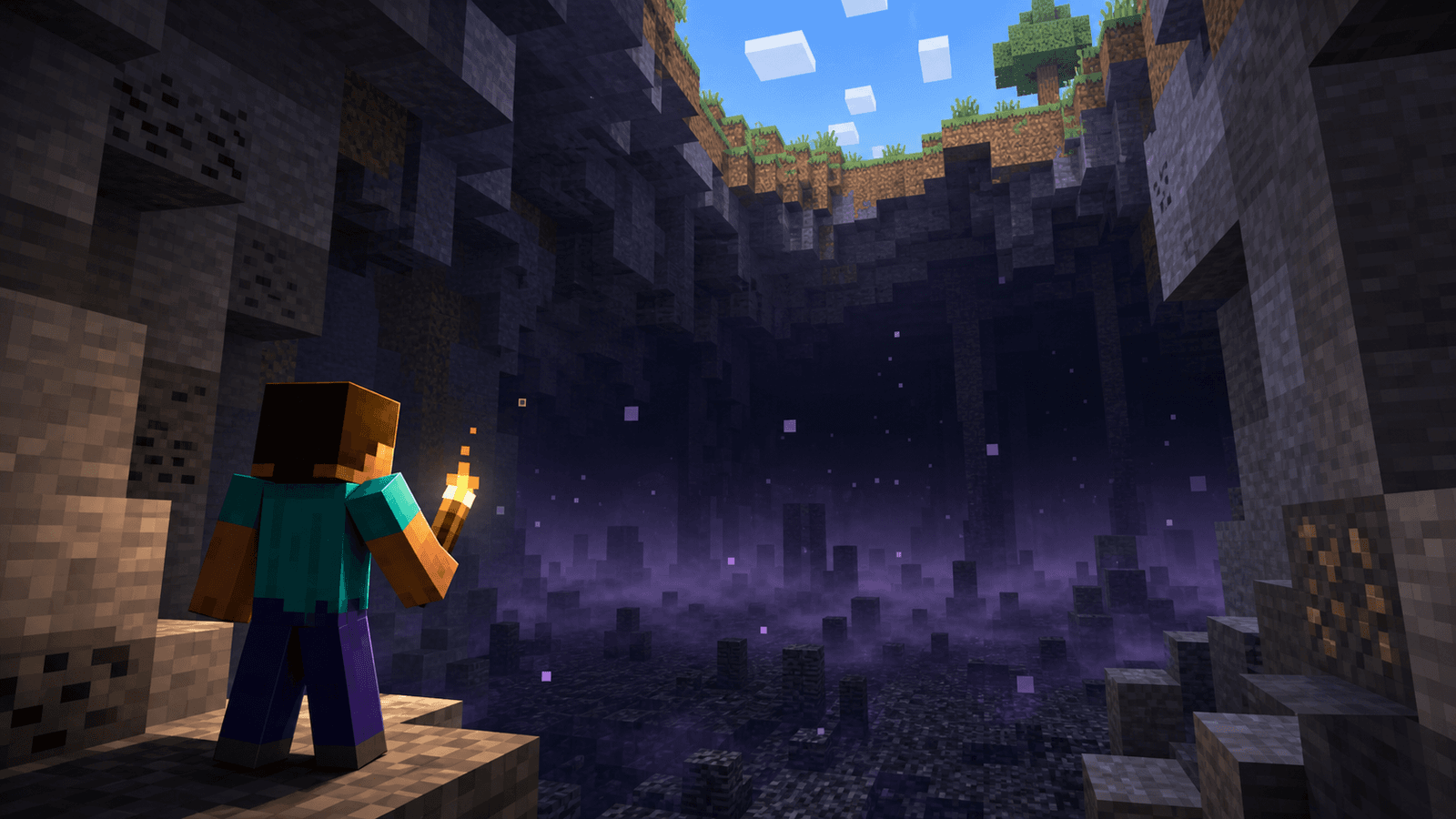


Void fog made depth feel physical
Void fog was never a structure, mob, block, or rule set. It was a visual pressure system. As players descended near the bottom of the Overworld, the world became increasingly obscured by dark fog and suspended particles. The feature made bedrock-level tunnels feel closer to the void even when the player was still inside normal terrain.
That distinction matters because Minecraft players often remember visuals as mechanics. A low cave could feel more dangerous with void fog even if the actual hazards were the same familiar ones: lava, mobs, darkness, bad navigation, and careless mining. It turned depth into a mood cue. The screen itself told players they were far below the surface.
For vanilla Minecraft servers, that kind of atmosphere changes how a world reads. A base at bedrock, a strip mine, or a deep storage hall can feel oppressive in an older client and clean in a modern one. The server may have identical survival rules, but the player's sense of danger changes because visibility changes.
Beta 1.8 turned fog into ambience
The clean history point is Beta 1.8, the September 2011 Adventure Update release. Minecraft Wiki history pages list underground void fog and depthSuspend particles among the features of that era. It belonged beside a larger mood shift: abandoned mineshafts, ravines, hunger, sprinting, villages, strongholds, and a broader push toward exploration.
Seen in that context, void fog was not random decoration. It helped the bottom of the world feel different from the surface. Early Minecraft already used darkness and limited visibility to make caves tense; void fog added a specific deep-world layer. It said: this is not just another hallway, this is the edge of the map's comfortable space.
That is why the feature still shows up in nostalgia talk. Players who miss it usually describe a feeling: deeper caves looked heavier, branch mines felt lonelier, and the lower world had a more hostile personality. Players who disliked it describe the other side of the same fact: it blocked sight lines, made building near bedrock less pleasant, and could make practical mining feel muddy.
Why it disappeared
Void fog did not survive into modern Minecraft. The Java 1.8 snapshot cycle removed both void fog and void particles in snapshot 14w34c. That matters because the removal was not a distant alpha footnote; it happened during the same broad era that made Minecraft's rendering and world presentation cleaner for long-term play.
The reason players still argue about it is easy to understand. Visual friction can be memorable and annoying at the same time. A horror-like bedrock layer is fun when you are telling stories about the old game. It is less fun when you are trying to build a storage room, run a public mine, record video, or teach new players where to go.
Community discussions around void fog tend to split along that line. Some players remember it as part of the beta atmosphere, often grouped with older lighting and darker-feeling caves. Others remember looking for ways to disable it because it made low-altitude building and mining harder to read. Both reactions are useful for server selection because they reveal the real tradeoff: immersion versus clarity.
What it means for server selection
If you are comparing vanilla Minecraft servers on the homepage server list, void fog should make you ask more precise questions about version and presentation. Is the server current Java vanilla? Is it an old-version survival world? Does it recommend a nostalgia resource pack or shader? Are promotional screenshots taken with default settings, or are they styled for mood?
Those questions matter because "vanilla" is a promise about what players will actually experience after joining. A current vanilla server cannot bring back old void fog as a server-side feature by wishing for it. An old-version server can have it because the client version includes it. A semi-vanilla or modded server can imitate the feeling, but that should be labeled clearly.
The same reading habit applies to related history topics like Minecraft's old lighting and Beta 1.8's effect on the Far Lands era. Visual history is useful only when it helps you separate the mechanic, the client, the map, and the marketing.
Better questions before joining
Good server listings do not need to explain every removed effect, but they should make the experience legible. If a server sells old cave mood, ask which Minecraft version it runs. If it sells current vanilla survival, ask whether resource packs, shaders, or client mods are optional. If it sells a preserved old map, ask whether new terrain continues under the old rules or modern generation takes over outside the archive.
For the best vanilla Minecraft servers, these answers are usually straightforward. The server names its version. It explains whether visual packs are recommended or required. It separates screenshots from rules. It tells players whether the nostalgia is in the jar, the map history, the community culture, or the art direction.
Void fog is worth remembering because it shows how small visual features can change a whole survival mood. It made the bottom of the world feel heavier, then vanished as Minecraft moved toward cleaner visibility. For server shoppers, the lesson is not that every world needs it back. The lesson is to turn atmosphere claims into concrete checks: version, client setup, visual defaults, and honest labeling on the Minecraft server list.