
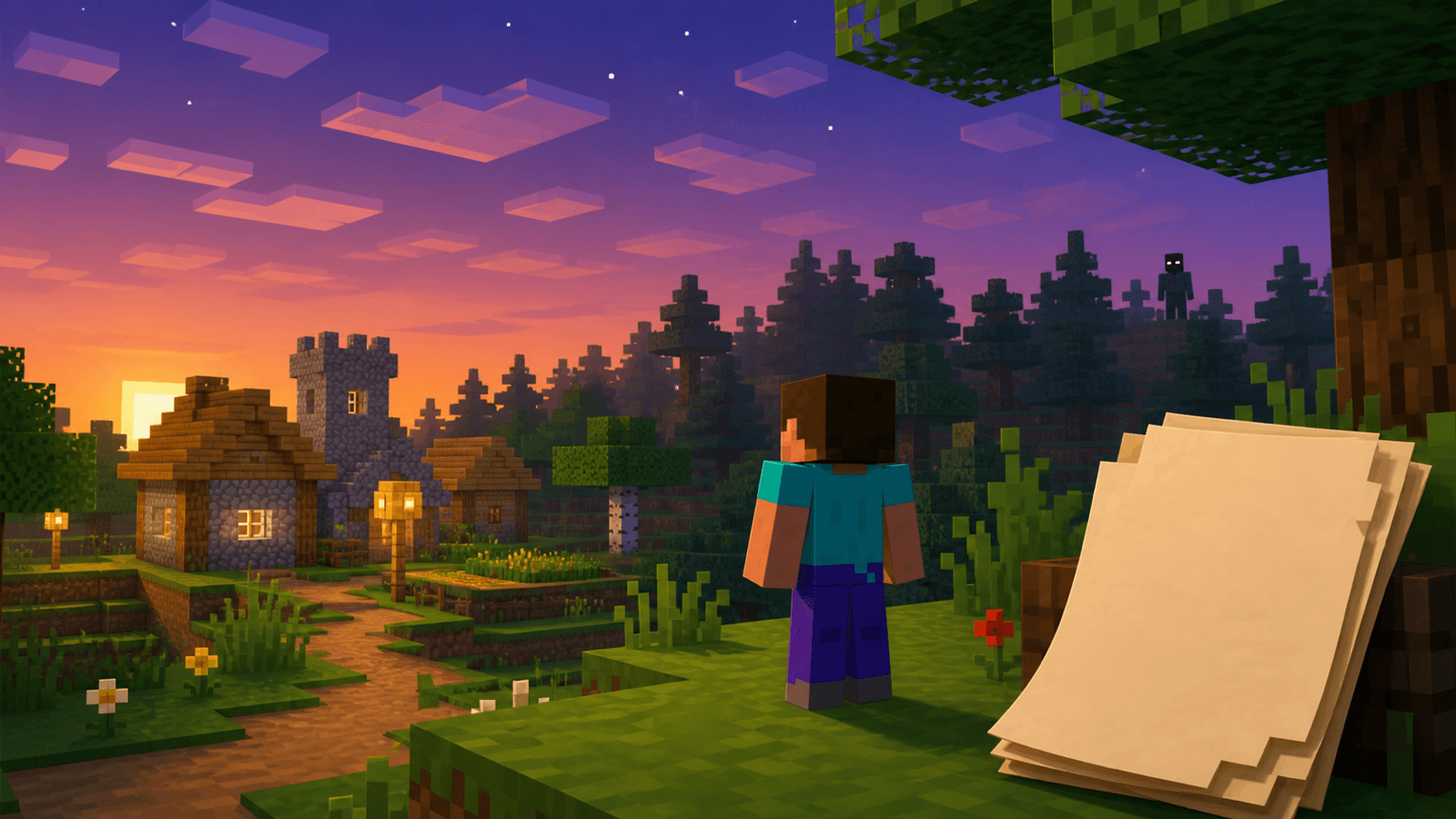


The joke was never a vanilla mob
Herobrine belongs to Minecraft's community mythology, not to the normal roster of mobs in an unmodified Java world. The white-eyed figure, strange tunnels, and unexplained structures became a story players could tell about the game's empty spaces. Mojang did not need to add a real creature for that story to affect how people talked about Minecraft. The myth was already doing cultural work before the changelog line turned it into a recurring punchline.
That distinction matters because “removed” sounds like a technical claim. In an ordinary vanilla installation, there is no supported Herobrine entity waiting to return after a bad update. A mod, datapack, plugin, skin, or player-made prank can create a Herobrine-themed encounter, but that is a different layer from the game version itself. A well-researched history therefore separates the community character from the official note instead of treating every old screenshot or anecdote as evidence of a hidden feature.
An archived Minecraft Forum discussion from January 2012 shows how quickly players had learned to read the line as a joke. Participants described it as a “running gag,” while also debating the older Human mob and the development-era code that had once made the wording feel more plausible. The thread is useful evidence of player interpretation, not proof that Herobrine was ever a normal survival mechanic.
The joke also became durable because it was easy to repeat. It needed no explanation for an experienced player, no new asset, and no change to world data. A single sentence could acknowledge years of folklore without making the folklore official. That economy is why the phrase survived even as the rest of Minecraft's update language became more structured.
The patch-note timeline keeps bringing it back
The historical record is less a straight line than a series of appearances. Early development-era notes used the wording around changes to the old Human mob, which is why players in the first wave of discussions sometimes tried to attach a technical explanation to it. By the time the joke appeared in release notes as a familiar closing beat, the cultural meaning was more important than any one class file.
Modern official notes make the pattern easy to verify. Minecraft Java Edition 1.16.2, published on Minecraft.net in August 2020, lists “Removed Herobrine” at the end of its Mobs section after concrete changes to Endermen, Zoglins, and Zombified Piglins. The Java Edition 1.20 notes repeat the line after changes to the main menu, credits, and other game systems. Java Edition 1.20.2 does it again after ordinary changes such as mob attack reach, villager curing discounts, accessibility, and networked play.
Those placements tell us what the note is doing. It is not a changelog category with a hidden gameplay payload; it is a deliberate cultural tag attached to otherwise serious release information. The official 1.16.2 page even puts it in a normal Mobs list, which makes the joke legible without claiming that a Herobrine mob was added or removed in the same way as a Piglin Brute.
Players noticed the rhythm. A Reddit discussion about the line's return in 1.20 describes the familiar possibilities—Herobrine “coming back,” infecting the game, or simply being part of Mojang's old joke. The humor depends on everyone understanding the gap between the literal wording and the documented mechanics. That shared reading is the real history of the patch notes.
What “Removed Herobrine” means for a Vanilla SMP
For a Vanilla SMP, the line is harmless only when everyone knows what is actually changing. Server owners still need to publish the Minecraft version, client compatibility, world-save policy, and any planned maintenance. A joke at the bottom of a changelog cannot answer whether a new release changes combat, generation, networking, or data-pack behavior. Those are the details that decide whether a long-running world can update safely.
The practical rule is simple: separate folklore from operations. If a server announces a version move, look for the real release notes and a clear maintenance window. If the server promises “pure vanilla,” ask whether that means no plugins at all, no gameplay-changing plugins, or simply a vanilla ruleset with moderation tools. Herobrine can be a theme or community event, but it should never be used to blur what software is running.
That clarity helps with newcomers. Someone searching for the best vanilla smp may arrive because they want the old atmosphere of Minecraft's mysteries, but they still need to know whether the world is current, old-version, lightly moderated, or built around a roleplay premise. The more a community relies on shared history, the more useful its onboarding language becomes.
The same principle applies to server storytelling. A town can keep a “Herobrine sighting” board, a build can use the white-eyed myth as decoration, and a moderator can turn a suspicious tunnel into a playful event. None of those choices stop being vanilla simply because the community is imaginative; they become a problem only when the listing presents a custom experience as an unexplained game mechanic.
Patch-note literacy protects shared worlds
The old forum discussion and newer Reddit reactions point to the same social pattern: players enjoy the joke because it rewards attention. People notice the last line, remember previous releases, and build a small layer of community continuity around it. That continuity is valuable on a Minecraft SMP. Shared worlds last when players have rituals—opening-day tours, public projects, update nights, or recurring jokes—that make the server feel like more than a disposable map.
But rituals need boundaries. A server should be able to say which parts are official vanilla, which parts are community lore, and which parts come from a plugin or datapack. That is not bureaucratic overkill; it is how a long-running community lets a new player join the joke without making them reverse-engineer the rules.
If you are checking vanilla Minecraft servers from the homepage list, look for the small signals of that discipline: a named version, a readable rules page, an explanation of resets or backups, and a description of how new players enter an established world. A server does not need to be humorless to be well-run. It needs to make the serious parts visible beneath the atmosphere.
That is also why old patch-note jokes remain useful historical material. They show Minecraft's unusual relationship with its players: an official changelog can carry a real bug fix, a technical migration, and a wink to a decade-old creepypasta in the same document. A Vanilla SMP inherits that culture, but it also inherits the responsibility to explain what is real in the world players are joining.
The lesson is to read the whole changelog
The history of Removed Herobrine patch notes is not a record of a monster repeatedly entering and leaving Minecraft. It is a record of a community joke becoming a reliable part of update culture, from early debates about the Human mob to official release pages that still place the phrase beside genuine changes. The joke lasts because the audience understands the context.
For players, the takeaway is modest but useful: enjoy the myth, then verify the mechanics. For owners, the standard is clearer still: let humor decorate an update announcement, never replace its version, compatibility, backup, and world-preservation details. A good Minecraft SMP can hold both mystery and precision.
Read the Minecraft blog for more history-led comparisons, then return to the server list with sharper questions about version, world age, moderation, and the kind of shared-world culture you want to join.