

The Adventure Update was really a two-part shift
The name is easy to remember and easy to simplify too much. The first part arrived in Java Beta 1.8 on September 14, 2011. The rest of the planned change continued into Minecraft 1.0, the release that finally turned the beta-era game into a full version. The split matters because players often remember one dramatic turning point even though the update arrived as a sequence of connected decisions.
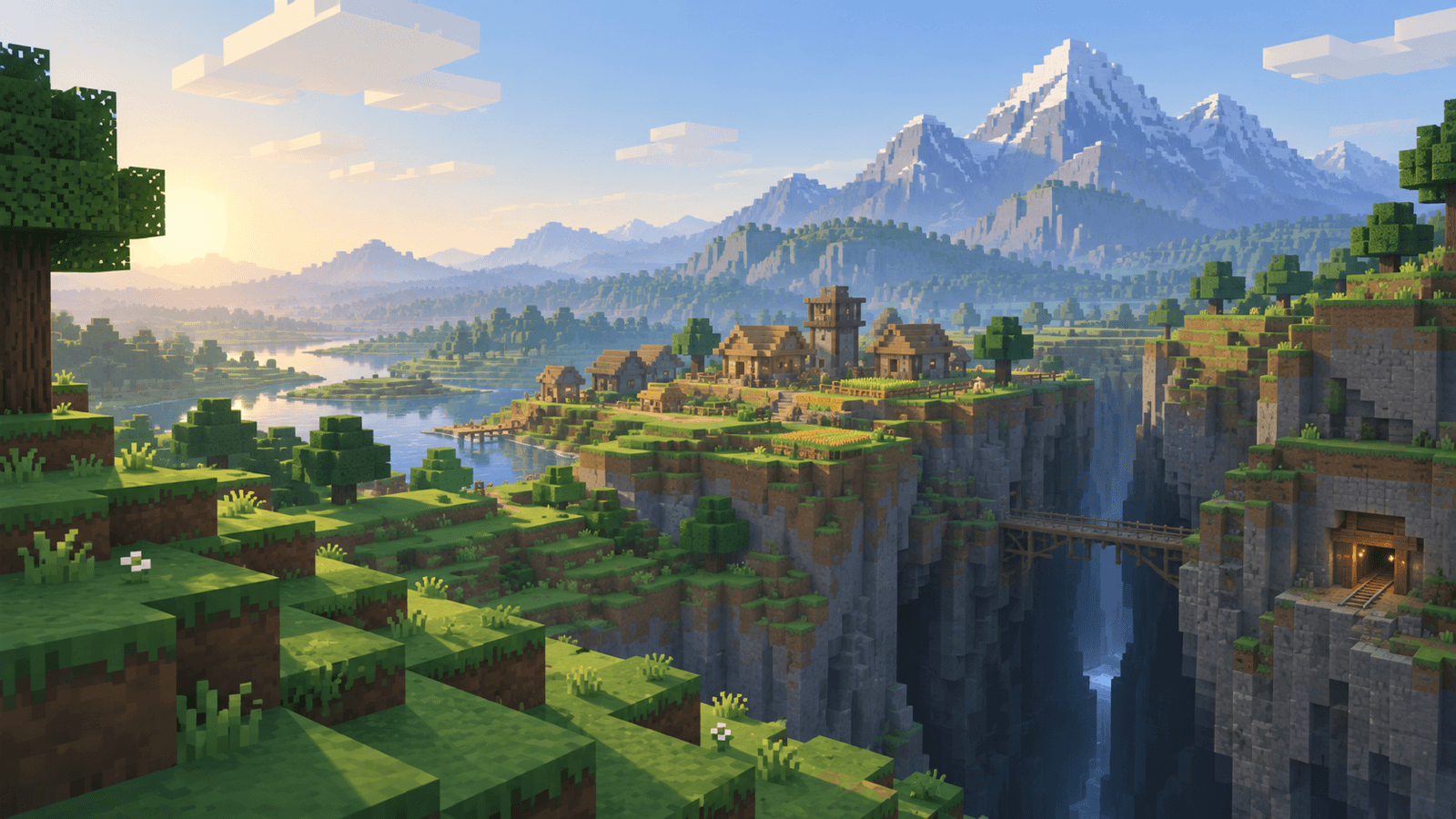
Beta 1.8 expanded the Overworld with new biomes, ravines, rivers, mineshafts, strongholds, and other reasons to leave the first shelter behind. It also introduced hunger and sprinting, which changed the relationship between movement, food, risk, and time. Minecraft.net's later histories still identify villages, mineshafts, glass panes, melons, fence gates, and Endermen with this Adventure Update era. The point is not that every addition was equally important. It is that the game began asking players to read the world as a set of opportunities rather than as an empty landscape waiting for a personal project.
For multiplayer, the update also made the server itself more legible. A contemporaneous Minecraft Forum guide tracked an SMP server list, player list, connection strength, custom seeds, and the effect of generating new terrain beside old chunks. Those details reveal what players were actually negotiating: not only new mechanics, but whether an established community could cross a version boundary without losing its shared map or its sense of place.
A world built around journeys changed the first week
Before the Adventure Update, a new player could treat the first base as the center of almost everything. Afterward, the map itself became a stronger social prompt. A mineshaft could turn a routine mining trip into a dangerous expedition. A ravine could become a landmark between settlements. A stronghold could give a long-running group a common destination even when nobody was in a hurry to “finish” the game.
That structure is excellent for a Vanilla SMP. A shared world needs reasons for players to cross paths, and exploration supplies them without requiring a custom quest system. One player finds a village, another builds the road, and a third turns a mineshaft into a public rail project. The update made those stories easier to start because it placed more memorable shapes in the world.
It also changed the meaning of preparation. Hunger made food a travel resource rather than a one-time emergency. Sprinting made distance feel manageable, but it made movement consume more planning. The result was a more active opening loop: gather, cook, travel, return, and decide whether the next trip is worth the risk. A modern minecraft smp still inherits that loop even when later updates add far more systems around it.
The cost of momentum was visible immediately
The Adventure Update did not simply make Minecraft “better.” It made the game more directed. Recent discussion in r/GoldenAgeMinecraft captures the disagreement clearly: some players see hunger and sprinting as the foundation of the Minecraft that followed, while others associate the same mechanics with a faster, less contemplative game. Players also argue about the new terrain, with some valuing its landmarks and others preferring the strange openness of earlier generation.
That disagreement is useful when evaluating a vanilla SMP. A server that runs current vanilla may benefit from the richer exploration loop, but it also needs to explain how quickly players can move through it. If a few people establish farms, travel routes, and high-end gear in the first week, newcomers may arrive after the most visible work is complete. The Adventure Update did not create that modern problem by itself, yet it established a rhythm in which movement and discovery could accelerate the whole community.
The old-world transition raised a second cost. The period Minecraft Forum discussion warned that new chunks could generate in radically different ways beside old terrain and that familiar seeds would no longer reproduce the same maps. That is a technical detail with a human consequence: version changes can leave a community living on a visible seam between memories. Owners of long-running worlds still need a policy for borders, backups, resets, and unexplored chunks whenever the generation rules change.
That promise is easiest to trust when the server writes it down before players join. A short version note can prevent weeks of confusion about client compatibility, world borders, and the pace a community is trying to protect.
What modern SMPs inherited from the update
If you are comparing vanilla Minecraft servers from the homepage list, the Adventure Update is a useful historical lens. Look for the same four questions it introduced: How does the world invite travel? How costly is movement? How quickly does progression accelerate? And what happens when the server changes the rules beneath an existing map?
The strongest answer is not always the newest version. Some communities want villages, structures, and a large exploration canvas because those features create more meeting points. Others want the quieter pace that older versions preserved. A best vanilla smp listing should therefore explain version, world age, reset policy, and progression expectations instead of treating “vanilla” as a complete description.
The update's biggest legacy is that it made the Overworld feel authored without making it linear. There are destinations, but no required order. There are survival meters, but still room to ignore the intended route and build a town. That balance is why its influence remains visible: modern Minecraft keeps adding reasons to explore while preserving the idea that the player decides what the journey means.
For a community builder, the lesson is practical. Keep the world readable. Publish the client version. Explain whether old chunks will remain untouched. Make food, travel, and server economy expectations visible before people invest weeks in a base. The Adventure Update changed Minecraft by making these choices matter to multiplayer, even when the server never calls them design decisions.
The lasting change was a new rhythm
The Adventure Update changed Minecraft forever because it gave the sandbox a stronger rhythm: prepare, travel, discover, return, and bring the story back to other players. Hunger and sprinting made that rhythm physical. Terrain and structures made it visible. The split between Beta 1.8 and 1.0 made it historical, because communities learned that a version boundary could change a world even when its buildings remained.
That legacy is neither a command to play old Minecraft nor a reason to dismiss it. It is a reminder that every Vanilla SMP chooses a pace, whether its owner says so or not. Read more Minecraft history on the blog, then use the server list to find a world whose version, exploration promise, and community expectations match the way you want to play.