

The trade is a biome signal
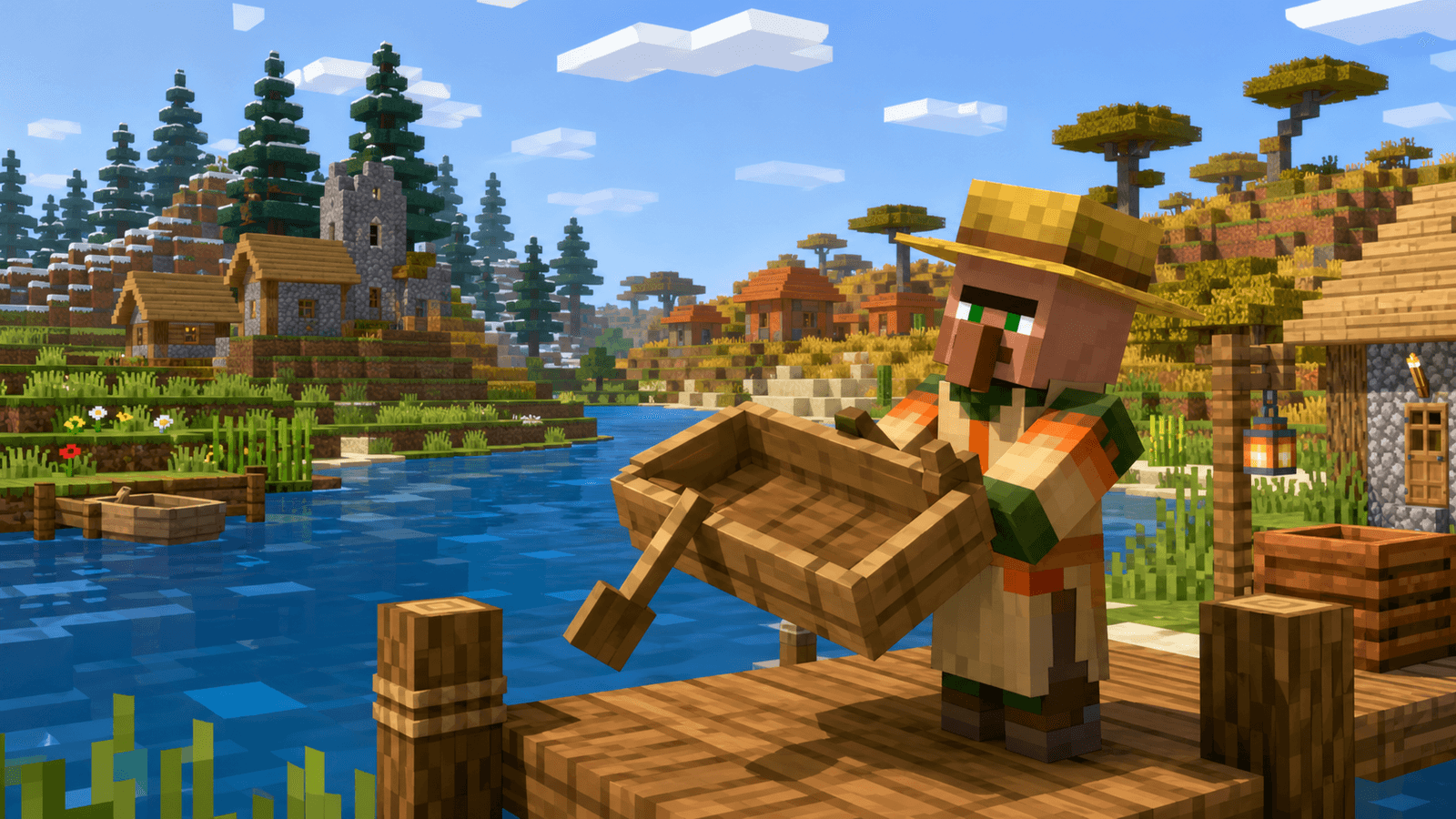
The source fact is simple, but more revealing than it looks. Minecraft Wiki's trading notes say the fisherman boat trade depends on the villager's biome outfit, and the village article ties village style and local wood choices to the biome at the village center or meeting point. Put together, that means a fisherman is quietly echoing the environment the village belongs to rather than offering a one-size-fits-all boat trade.
That matters because villages are not only loot stops. On well-run vanilla Minecraft servers, a village is also an information hub. Its layout, beds, paths, workstations, and wood palette tell players what kind of start they have found and how expensive it will be to turn local materials into emeralds. A fisherman who wants the matching boat confirms that the server is still letting biome context flow into the economy instead of flattening everything into one abstract trade menu.
The point is not that every player should memorize every boat variant before joining a server. It is that vanilla survival rewards players who notice low-friction signals. If a multiplayer spawn drops new players near rivers, taiga routes, savanna coastlines, or mixed-biome villages, the fisherman trade gives them another way to read the area before they commit to a base, a transport plan, or a shared villager setup.
Why it matters on vanilla Minecraft servers
On a private single-player world, this is just a neat fact. On vanilla Minecraft servers, it can shape the first hour for several people at once. A group that understands local trades can coordinate faster: one player gathers the matching wood, another maps nearby waterways, and another turns a village into a modest emerald source while the rest secure beds, food, and safe paths.
Community discussions around villager economies make that clearer. In a January 29, 2023 Reddit thread about early emerald routes, players kept comparing fletchers, farmers, masons, and fishermen rather than treating one trade as universal. One commenter pointed out that the fisherman boat trade can be efficient in raw logs once unlocked, but also noted that reaching that trade takes more setup than simpler early-game options. That is exactly the right lens: the value of this mechanic is situational, and the surrounding world decides whether it feels elegant or annoying.
That changes the feel of server onboarding. Some worlds are generous because spawn sits beside forests, rivers, and intact villages. Others are slower because players must cross hostile terrain or compete for the same stripped-down starter resources. Before joining, compare the rules, map age, and community habits on the vanilla server list. A fresh map with accessible villages can make the fisherman route practical. An older world can still be better overall, but only if the community has preserved enough village function, public routes, or new-player guidance that you are not locked out of basic progression.
The real server question is village health
The bigger question is not whether a boat trade beats every other emerald route. It is whether the server still has places where small village mechanics can survive long enough to matter. A February 2026 Reddit post about server-wide trading halls shows that many multiplayer players still care about systems that all players can use, not just one locked-down private setup. A long-running Minecraft Forum discussion about villager changes makes the same tension explicit from the other direction: one player argued that giant halls can concentrate wealth with one owner, while another preferred letting villagers remain part of a player-built village instead of over-engineering everything.
That tension matters for vanilla Minecraft servers because it changes what a newcomer sees. In one world, villagers are still embedded in recognizable villages, docks, roads, and public starter spaces. In another, all meaningful trading has been collapsed into a private hall that only established players really know how to use. The fisherman boat fact is tiny, but it exposes which kind of world you are entering.
That is why a subtle real-world example can help here. The Peaceful Vanilla Club server page is relevant not because this article needs to advertise it, but because its local wiki corpus documents preserved villages, public villager trading spaces, guest huts, and other newcomer infrastructure. That is exactly the kind of long-term world design that keeps a small trade clue meaningful instead of burying it under private logistics.
Use that signal as a pause before browsing onward. The strongest servers keep minor mechanics readable, so players can turn village clues, routes, and community upkeep into practical choices instead of guessing from a label alone.
What to check before choosing a server
The best vanilla Minecraft servers do not need custom features to make this kind of detail meaningful. They need world conditions that let ordinary mechanics stay relevant. Look for clear grief rules around villagers, a map that has not had every nearby village stripped of beds and workstations, and enough route-building that players can actually reach useful settlements without turning the early game into a punishment.
Map age deserves special attention. A long-running world can be richer than a fresh reset, but only if established players have built infrastructure for newcomers. Public docks, marked roads, shared villager areas, and obvious spawn paths keep vanilla multiplayer readable. Without those supports, a new player may never reach the stage where biome-specific fisherman trades matter at all.
Server culture matters too. Some communities treat every village as private property. Others maintain shared settlements where basic trades stay open as long as players replant, repair, and avoid griefing. Neither style is automatically wrong, but they serve different players. If your goal is a relaxed survival world, choose a server whose rules explain how village resources should be handled rather than leaving everything to private negotiation.
For more comparison angles, the blog is a good place to keep moving from one mechanic to the next. Small details like fisherman boat preferences, mob transport, village preservation, and public farms all point toward the same larger question: will this server make vanilla systems feel alive, or will it flatten them into a checklist?
The practical read for players
The fisherman boat fact is valuable because it teaches a useful habit. When joining vanilla Minecraft servers, do not only ask whether the listing says "pure vanilla." Ask whether the world still gives ordinary mechanics room to breathe. A server can run very close to default gameplay and still feel poor if villages are exhausted, spawn is chaotic, and new players have no clear route into the economy.
In play, treat the trade as a quick diagnostic. Find a village, identify the fisherman's biome outfit, check the boat type, and decide whether the surrounding area supports that route. If it does, you have a clean starter loop and a reason to map nearby waterways. If it does not, you have learned something just as useful: this world may require a different first plan, or it may not be very newcomer-friendly at all.
That is the real lesson behind fisherman boat trade vanilla minecraft servers. The trade itself is small, but the decision it encourages is large. Good vanilla multiplayer is built from ordinary systems that remain understandable, renewable, and worth noticing. A fisherman asking for the right boat is one more signpost for players trying to choose a world where survival knowledge still pays off.